Friday, May 19, 2006

Miracle-Gro

Monsanto : Retarded children are a small price to pay for immaculate golf courses. - Jim Earl
Heard on the Marc Maron radio show.

Seacrest out.

Thursday, May 18, 2006

Dips

Looking at the stock market the last few days, I have little doubt, however naive, that the professional profiteers earn their keep by keying on sudden drops in valuation. I usually hear it referred to as "profit taking". The amateur investors chug along the upslope and earn money gradually over the long term, but never respond quickly enough to the "market correction dips" and so predictably and routinely contribute to the transfer of wealth from the hoi polloi to the oilogopoly.

Since the investor class has virtually invented this collapsing Ponzi scheme to making money (perhaps more properly extracting money), it would not surprise me if resource consumption, when left to purely market forces, follows this same profile. Unfortunately, or fortunately, depending on you point of view, the collapse can only happen once.

I modeled this previously in an oil depletion context; looking back it essentially demonstrates that given powerful enough extractive techniques, big oil may just create the biggest, longest Ponzi scheme ever encountered. With but one twist. The rebound can't depend on the sucker class getting lured back in, because oil molecules don't have gullibility genes. It will end in The Overshoot Point and we will, for the long term, have to get use to different levels of productivity and sustainability.

The oil companies will eventually run out of petrol, but by that time, they will own everything in site from earlier bubble bursting exercises, the cashout from Wall Street earnings into hard currencies providing all the leverage necessary.


First ketchup as a vegetable, then trees polluting and now CO2 as a miracle gas.


A couple of know-it-alls, John Stossel and Peter Huber, engage in a mutual admiration videoclip here, as they discuss a rosy oil-rich future. For some reason, this preposterously absurd quote from Star Trek seems fitting:
Daystrom:"Twenty years of groping to prove the things I'd done before were not accidents... seminars and lectures to rows of fools who couldn't begin to understand my systems... colleagues, laughing behind my back at the 'Boy Wonder' and becoming famous, building on my work -- building on my work!"

Bones: "Jim, he's on the edge of a nervous breakdown, if not insanity."
Stossel: libertarian wonder boy.

Wednesday, May 17, 2006

Linearity and Conservation

Human beings appreciate linearity. We cope with an analog world by applying linearity. For example, most audio systems use principles of linearity to avoid distortion and provide a wide dynamic range. Linearity enables an audio amplifier to range from a whisper to a scream with nary a change in a waveform and allows the use of the same electronic analog filter independent of volume.

The oil shock model exhibits the same properties of linearity. Acting as a response filter on an initial discovery impulse, given the same scaled input stimuli, we should expect the same scaled production profile, assuming that we keep the same rate parameters.

But, in the real world, should we expect this scaling to naturally occur? In short: yes. And the simple reason why: greed.

Say that the USA had a single delta discovery of x GBls of oil in 1930. And that this contributed to a production profile that peaked in 1970. Given the same extraction rates per unit volume, we should expect that the profile would look exactly the same except for the height of the peak, if instead of x GBls we had found an extra 10x Gbls worth of oil in the original discovery.

But truly this only makes sense if we add the greed quotient to the equation. With human greed doing its part, the 10x worth of oil would have flowed like water. Civilization would have used the excess cheap oil for outdoor air-conditioners in Palm Springs and a myriad of other activities that we would consider nowadays as wasteful. For the same reason that we can suck every last drop out of the Colorado River or shoot every last passenger pigeon out of the sky, we would have used up the same fractional volume of oil by now, no matter how much we originally had.

Conservation remains the only route to stem the tide.

What not to do? Act like a JackAssMissile.
This morning, the Democrats gave a news conference on energy independence. It was the usual melange of Bush bashing and fantasy; Chuck Schumer said that $3 a gallon for gasoline is a metaphor for the Bush administration's incompetence, and John Kerry said that we need to invent our way to energy independence. A good idea, as long as we aren't counting on Kerry to do the inventing, and we have a plan for what to do in the meantime.

Dim Dick Durbin had the most concrete suggestion: burn corn!

I'm well aware of the political power of ethanol, and of its utility, at the margin, as an energy source. But the idea that burning midwestern corn can replace burning petroleum is absurd. And there has been, for a decade now, a concrete proposal on the table whereby Americans would work at good-paying jobs to produce energy that would reduce this country's dependence on foreign energy sources. But the Democrats have successfully blocked drilling for oil in ANWR, time after time.

"Energy independence" is one more in a long series of issues on which the Democrats have nothing serious to contribute.
Now let's put the thoory of greed to practice. In this case, drilling in the Arctic National Wildlife Refuge would just continue to feed the greed machine. Pointing out any opposition to drilling there, the wingnuts implicitly suggest that enviornmentalists violate the 'minionist's goal to support the linear law of greed. When all else fails, conservation remains the only negative feedback in the loop to keep the mighty wurlitzer amplifier in check.

Ask anyone who has built an audio amplifier the utility of negative feedback, and you will understand.


Update: Interesting link on linearity.
Here’s the fundamental fallacy of linear thinking: if you think something is good, you just do more of it and pretend that this will make the future even better. Such thinking also can be (and has been) used to justify fantastic levels of inequality that more integrated types of thinking would simply see as absurd. If we really are in it together, over the long haul, then of course what happens to any segment of society at any time has an effect on the rest, just as every element in a closed natural cycle is important to the health of the whole. But unhook the parts from the whole, unhook humans from nature and from each other, and set them each on a separate line towards an ultimate end point, and this is what you get: each against all, a society of parents simultaneously bludgeoned and bedazzled into stealing the future from their children, or their grandchildren.

Monday, May 15, 2006

Reserve Growth Recap

I have gone around the bend a few times trying to understand the conundrums behind the concept of "reserve growth". What exactly causes the majority of the grief, I can't say for sure, yet I can volunteer the extenuating issues and points of contention:
  1. Hard to tell the difference between reserve growth and new discoveries.
  2. Some reserve growth rates, when extrapolated, point to infinite URR.
  3. Most reserve growth rates as extrapolated won't even begin to keep up with demand.
  4. Areas that show reserve growth look good for awhile but when they get shut down, they get removed from the data set.
  5. (follows from 4) If reserve growth does hit an asymptote, no one ever notices it, because it gets removed from the data set the minute it shows problems. This makes the concept of "reserve growth" a veritable pot'o'gold at the end of the rainbow for the cornucopians, because the contradicting evidence does not exist.
  6. Certain areas show huge reserve growth (e.g. USA) but still hit peak oil. Other areas show little reserve growth, have honest reporting (e.g. UK and Norway) and of course hit peak oil.
  7. Reserve growth predictions become heavily politicized and filled with legal technicalities because of the potential for fraud. The reserve growth effect itself could perhaps result more from an artifact of the reporting technique than anything else. For example, see the SEC regulations prohibiting "speculative" estimates.
  8. Look up the concept of "creaming curves" and try to distinguish creaming from reserve growth without going nuts.
  9. Even though potentially promising regions in the world harbor dictators or fiefdoms or inhospitable natural environments, many people hold out for the hope of unknown amounts of reserve growth there. Daunting prospects, I say.
  10. Lastly, "Mars, bitches!". Because growth extends to the limits of the universe.
As I have struggled with trying to resolve all these point simultaneously, my blog postings on the subject have shown at least a maturing of my understanding.

I started by looking at creaming curves here.

I saw some intriguing data on huge reserve growth in the US reported by the USGS, and tried to brush it aside a bit pedantically here.

I almost convinced myself that reserve growth would not have an impact here.

I gave a shot at modeling reserve growth by applying conventional parabolic growth mathematics here.

I finally caught on to understanding SEC regulations on reporting here and added some thoughts on asymptotic limits to growth.

I found a few place where reserve growth showed little potential here.

I started to comprehend how reserve growth will lead to wildly asymmetric depletion profiles here.

And that you could achieve infinite URR without asymptotic limits here but that it makes little difference in the end.

Finally, I give some pointers on how to argue this whole issue from a position of true understanding here.

Trip, strange, long. If that is our destiny, you cannot change it. But do not go in fear, Grasshopper. Fear is eternal darkness. Go instead with inner strength. For it is like a deep river, into which all streams flow. It increases, always moving forward. And soon, there is nothing that can stand in its way.

Sunday, May 14, 2006

Addled Age

Not that I would even consider putting an advertisement on a blog, but the fact that some of these ads promote huge, over-the-top pipe dreams has started to concern me.

Found on Josh Micah Marshall's Talking Points Memo blog, an advertisement for 2 trillion barrels of parking lot asphalt.

Speaking of Marshall's blog, I lifted Cheney's scribblings (see left margin), and thought about his slight improvement in favorable poll ratings. I heard it went from 18% to 20%. To explain this, I figure that perhaps a sixth of the U.S. population consists of rednecks and self-styled militia who would like nothing better than to see (a) Cheney shoot someone or (b) see Cheney make fun of a hoity-toity ambassador. At some point, a pol's ranking should hit some Neanderthal bottom whereby other Neanderthals can actually raise his rating when they see him doing something stupidly Neanderthal. They realize that they have finally found their guy. Ergo facto profundo, Cheney's favorability ratings go up.

And another thing. I figure ordinary spam may turn out as a plus for these BushCo times. Consider that since the spooks in the security agencies have started monitoring everything said over any medium, a flood of meaningless messages should give us a sense of privacy. Before they read my meaningless tripe they have to wade through 1000x as much other meaningless tripe. Random noise can become an ally in our fight against an imperial presidency.

I also bet that given that they have monitored over 2 trillion numbers already, that the number of false positives, such as wrong numbers and inadvertent calls, swamps anything that they would conceivably find as an authentic terrorist lead.

Friday, May 12, 2006

Norway would if they could

Any wonder that Norway should consider going the green route outlined by scandihoovian neighbor Sweden? Someone at peakoil.com recently posted updated Norway oil production data. The fact that Norway, along with the UK, release this information to the public, shows a lot of candor on their part. Commendable, yes, but it still appears that oil production continues to drop like a rock with the March '06 number.

For the model, I used the following extraction rate shock curve to match the earlier data above. If anything, the extraction rate may have increased beyond the conservative cutoff I originally applied, beyond a value of 0.24 depletion of available reserves per year. This means the time constant has essentially dropped well below 4 years.
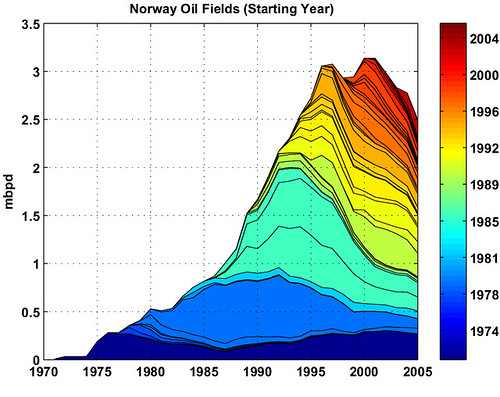
Graphoilogy used the data to come up with a multiple-oil-field production profile view. The more I look at it, the more it reinforces the notion that a definite bifurcation occurred in production rates. Around 1991, extractive effort has to have ramped up considerably, which has served to sharpen the production profiles in the individual regions. Look closely as the early individual production curves show rather broad profiles (with significant reserve growth in the oldest field) while the later production curves consist of half-widths of just a few years.